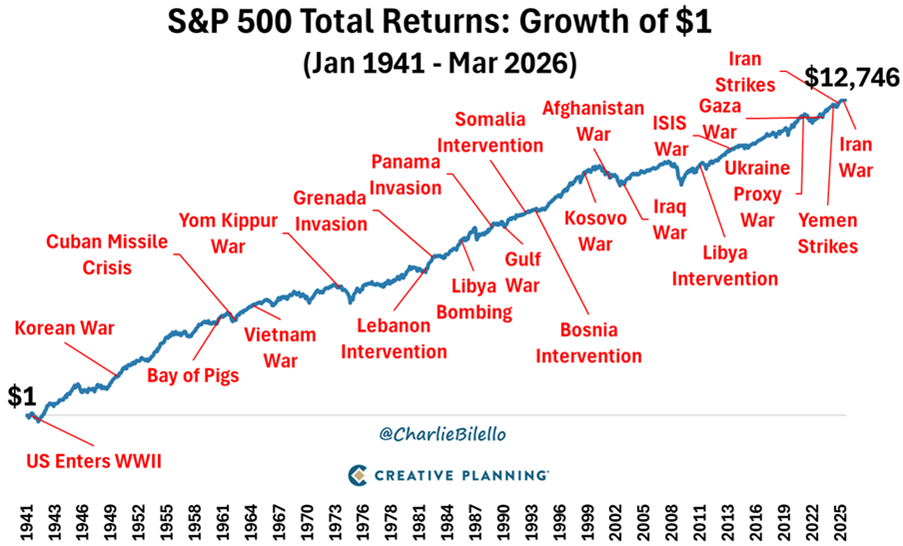
Wars and Stock Market Returns…
In case you missed it, there is what seems to be the beginnings of a potential war occurring in the middle east. Oil prices are spiking, there has been some volatility in the markets and President Trump seems to be doing what President Trump does and that is tweeting to move the market (whilst we see MASSIVE trading volumes just before his tweet).
It is completely normal to feel a little concerned with the state of the world right now. In fact it, to me at least, it feels like this has been a pretty consistent feeling over the part 6 years since Covid. As Engage clients you are all well trained to ignore the consistent news cycle where the lines between click bait headlines and newsworthy stories can be blurry to say the least.
Whilst ignoring the noise is always the best way to be, we do realise that it’s not easy and so to give further comfort, I’ve outlined some data below to support my narrative of this time is no different, and markets will prevail.
Investors are asking what typically happens in the stock market after the start of military conflicts.
The answer: there is no typical outcome. Every single time is different.
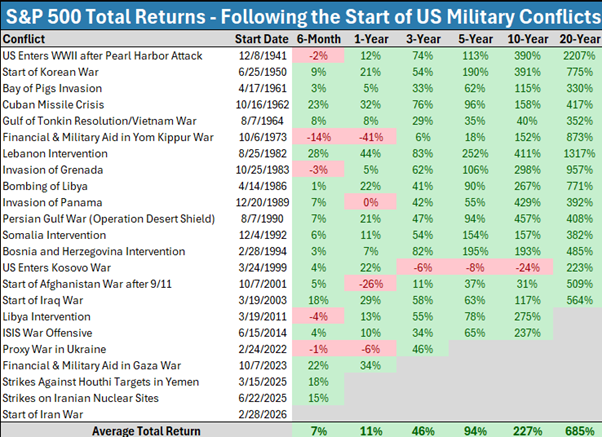
And that should make sense because there are so many variables that influence the stock market and so many unknowns when it comes to wars.
Just a few of the many questions today:
· How long will the war last?
· Will it expand into a regional war?
· How long will the Strait of Hormuz be closed and what impact will that have on the price of oil/gas?
· Will the US send ground forces?
· Will Russia or China intervene?
· What is the endgame?
· What are the economic consequences?
None of the answers to these questions are known today.
The best we can say looking at military conflicts in the past is that with the passage of time the stock market has tended to rise, and the more time that has passed, the more it has risen.
That’s true for two reasons: a) all wars eventually come to an end, and b) the economy and earnings, even if impaired in the short run, still tend to grow in the long run in spite of these conflicts.
Which is to say that the world always looks chaotic in real-time and equity markets always look resilient with enough hindsight.