
Is Now the Right Time to Invest?…
This is one of the most common questions we hear.
Let’s start with “why do we invest”?
If you are saving for the future or your retirement you’ll want, and need, those savings to work hard for you.
They need to grow by more than inflation just to be able to afford to buy the things you buy today but in the future! And most of us want to be rewarded for putting money away today, so that it might be able to buy us more in the future.
Buying and investing in ‘real’ assets that can grow with, and by more than inflation is therefore what we recommend to clients to achieve this. Cash over the long term just doesn’t cut it.
Contributing regularly to a diversified investment portfolio that aligns with your financial plan and is invested tax efficiently is a great approach, in our opinion.
Occasionally there may also be times when significant lump sums are available to invest from inheritance, bonuses, divorce, lottery wins or significant salary increases. The same approach applies and once invested it has the long-term benefit of compounding adding to the returns.
However, when markets reach record highs, or when there is lots of fear and uncertainty in the news, investing cash at that time can feel like a timing mistake. When investment values have risen a long way it seems intuitive that it can’t be sustained and will fall sooner rather than later.
It’s in these moments that some investors decide that it is sensible to wait for the investment value to decline before investing more money.
In this article, we look at the facts and a strategy to build an inflation-beating investment strategy when investing new money.
New Highs Are Normal
To make better decisions at these times, we should understand how often market highs occur.
A new high is a new record. On the sports field, records are celebrated because they are rare and can remain unbeaten for years if not decades.
However, for investment markets that grow over long periods, it is more normal and we should expect regular new highs. If the general direction of movement is upward, the market tends to spend much of its time passing its previous high-water mark and setting new highs.
Obviously markets do not move up in a straight line, but waiting for a 10% correction might only come after the market is up another 20%, which means missed opportunity.
This can be the cost of waiting.
The emotion of investing when uncertainty is high
It is entirely understandable to feel hesitant about investing when markets are at or near all-time highs or when the economic outlook appears uncertain. Emotionally, it can feel as though the potential for gains is limited while the risk of losses is heightened. Investors often worry that they may be buying at the peak, only to see markets fall shortly afterwards.
Periods of uncertainty can make these concerns even more pronounced. Headlines about geopolitical tensions, the rapid development of artificial intelligence, persistent inflation, and the possibility of further interest rate increases can create a sense that risks are everywhere. The constant flow of information can make it difficult to distinguish between short-term noise and long-term investment fundamentals.
However, successful investing often requires looking beyond current headlines and recognising that markets have historically navigated wars, recessions, technological revolutions, political upheaval, and changing interest rate environments. While uncertainty can feel uncomfortable, it is a normal feature of investing rather than an exception.
Markets continually adapt to new information, and long-term investors are often rewarded for remaining disciplined and focused on their objectives rather than trying to predict the perfect moment to invest.
What if I was right to wait
Let’s say the market decline arrives imminently as you expected. The noise around the bad news will also begin to increase and what you expected to be a obvious buying opportunity will rarely feels like one in the heat of the moment. When will you be brave enough to invest, or will the greater volume of bad news keep you waiting for the next decline? There are some investors who that took money out of investments during the Great Financial Crash (GFC) of 2008, but many didn’t get back in until years later when markets were higher than when they sold.
We believe the best investors know their timing will never be perfect, but they decide to invest because their time horizon is long; they don’t need the money tomorrow and money is being invested to be able to buy more in the future.
Time is on your side
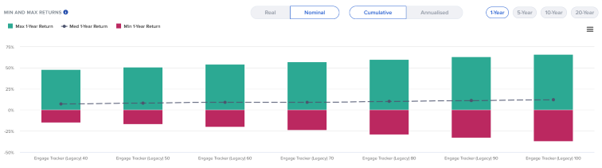
With almost 110 years’ worth of data the probability of a negative return in the first year of investing isn’t insignificant, which might put some off starting.
In fact, for a 100% global equity portfolio the greatest 1 year’s drop was -37% (which was March 2008 to February 2009 and the GFC) while the largest return was 66%, and the average return was +12%. You might not like the chance of losing money in year 1 and that is understandable, especially if there is lots of bad news and markets are at their high.
But when you look at the best and worst outcomes over 10 years, the best cumulative return is 837%, -5% is the worst, and the average annualised return is 10% (charts below). To put the worst return in context, it was the 10 years ending at the lowest point after the Great Financial Crash in February 2009, and the following year experienced well above average returns.
Most clients have investment portfolios with less than 100% global equities, usually averaging around 60 to 80%.
The worst 10-year return for those portfolios would have been between +12 to +30% and were also to the lowest point of the Financial Crash.
The probability of a good return improves with time and is dependent on the mix of investments.
1 Year returns
10 Year returns
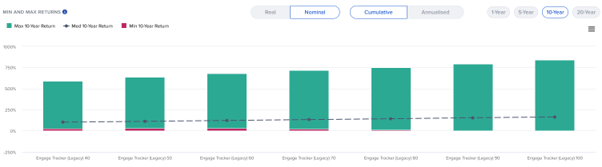
Data is from 1915 to 2024
Putting Money to Work
More important than market predictions is controlling what you can control. Money you will not touch for many years belongs somewhere quite different to money you need soon. Getting that right does more for your long-term results than attempting to guess the markets’ next turn.
If looking at the above charts you still believe you are the unlucky one, and you’ll be the one to invest at the worst time, there is some good news and a strategy.
It’s called ‘phasing’; investing at regular intervals. The added advantage is that this can be flexible and finessed to manage the perception of short-term risks and investment risk, BUT it is important to get started and have a plan to phase the money over an expected timeframe. This is how we’ve helped lots of clients feel comfortable about investing at periods of perceived heightened uncertainty.
Feeling uneasy at a high is normal, but it does not need to stop you from achieving your financial goals.
History shows that a market decline can start at any time, and most are unexpected, but if you have money to put to work a record high is not a reason to hold back.