The 2026 Budget: “Breathing space for today. Fresh hope for the future”
The Chancellor’s words, not ours.
Let’s see what we think, and what we think that means for you.
I remember a time when duty on booze and cigarettes would be the main Budget headline. Times have certainly changed. For anyone harking back to the “naughties”, there was at least something reassuringly familiar: alcohol duty will rise in line with RPI from 1 February 2027.
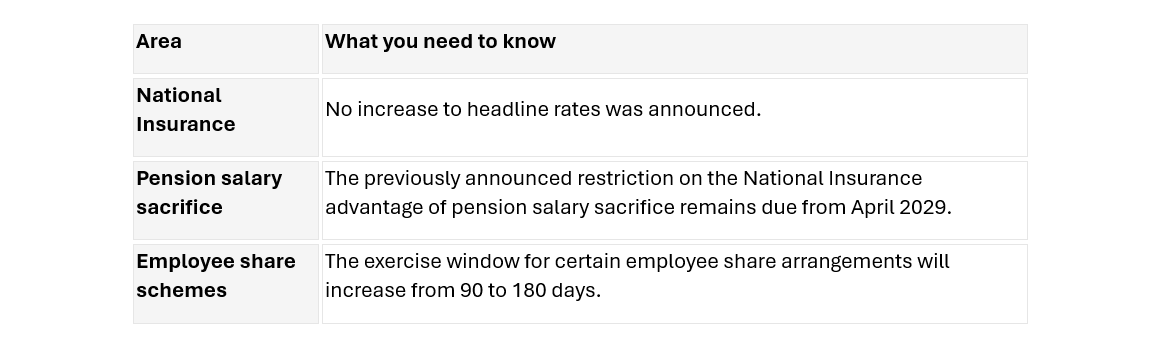
Beyond that, this was a relatively restrained Budget. There were no increases to the headline rates of Income Tax, National Insurance or VAT.
UK markets appear to have accepted the announcement relatively calmly, although questions remain around borrowing, spending pressures and how credible the longer-term plans for reducing the deficit will prove to be. The Office for Budget Responsibility (OBR) now expects the deficit to fall from 4.2% of GDP this year to 3.4% next year and around 2% in three years.
For individuals and families, however, no headline tax rise doesn't mean no change. Higher taxes on savings and property income are coming, tax thresholds remain frozen, and previously announced changes affecting pensions and Inheritance Tax are drawing closer. There are also important changes for entrepreneurs and business owners.
So, as financial planners, we think the more useful question is not simply “What did the Chancellor announce?” but “Does any of this change what you should be doing?”
Personal tax: more change beneath the surface
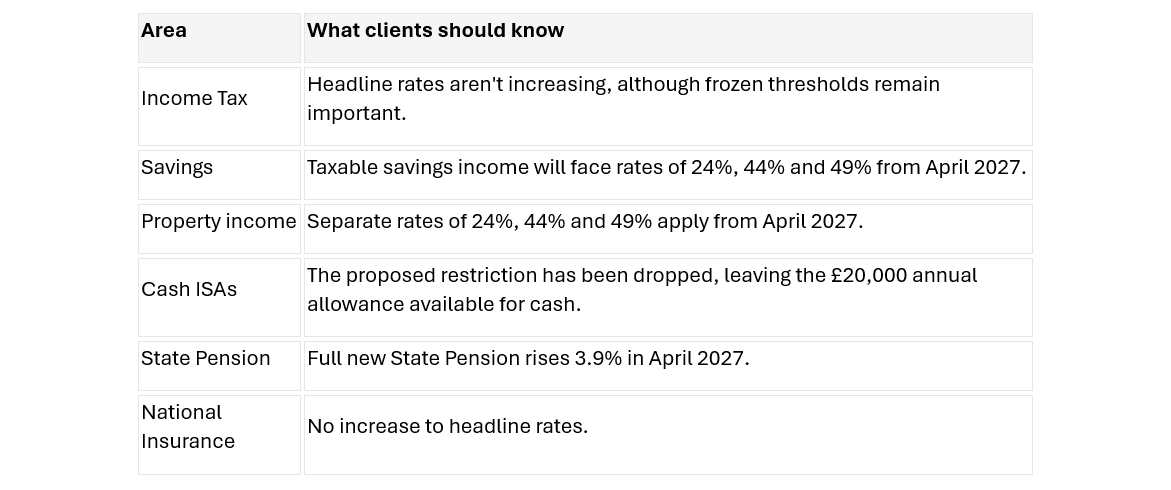
At first glance, this looks like good news. There has been no increase to the headline rates of Income Tax, National Insurance or VAT.
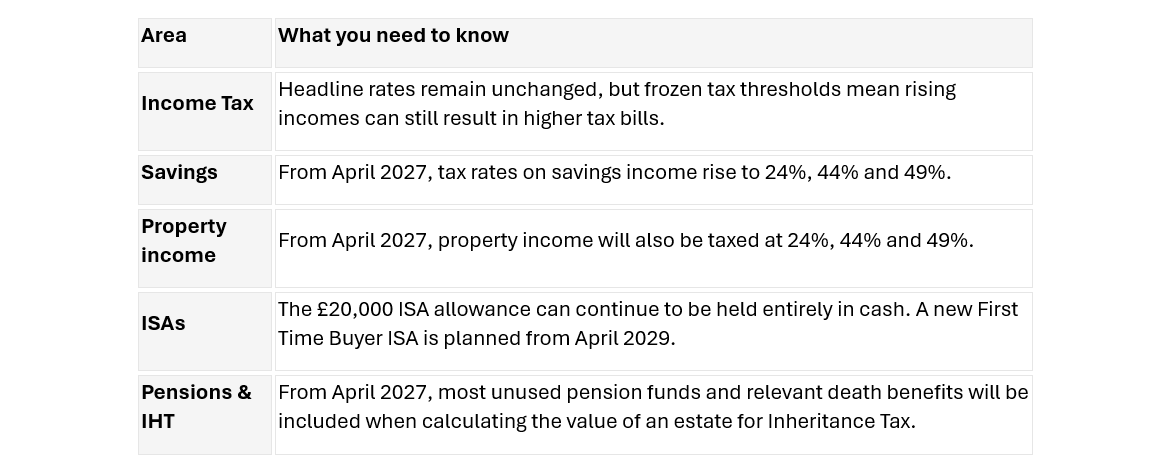
However, Income Tax thresholds and the Personal Allowance remain frozen. As incomes and pensions rise, this can gradually pull more income into tax, or cause more of someone's income to be taxed at a higher rate.
The tax treatment of savings is becoming more important
One of the changes we think will be particularly relevant to clients holding substantial cash deposits outside ISAs is the taxation of savings interest.
From 6 April 2027, taxable savings interest will be subject to rates of 24%, 44% and 49%, depending on the individual's tax band. That is 4% added to each income tax band.
The good news is that the proposal by the previous Chancellor to introduce a 22% tax on cash interest in an ISA has been scrapped, along with plans to tinker with Cash ISA subscription amounts. The ISA allowance remains to be £20,000.
As tax on savings interest increases, the value of making sensible use of tax-efficient allowances increases with it.
That does not automatically mean moving cash into investments. Cash has an important role in most financial plans. It does mean that where large amounts are being held outside tax-efficient wrappers, there is an increasingly strong case for looking at whether that cash is being held in the right place.
Landlords
Property income will also have its own rates of 24%, 44% and 49% from 6 April 2027.
For landlords, particularly those with significant taxable rental income, this provides another reason to look carefully at the true return they are receiving after tax rather than focusing solely on gross rental yield.
Pensions and the State Pension
The full new State Pension is set to rise by 3.9% in April 2027, taking it to just over £13,000 a year and therefore above the £12,570 Personal Allowance. A new Pension Tax Allowance is intended to ensure that pensioners whose total income is no higher than the full new State Pension will not pay Income Tax between April 2027 and April 2030.
The Triple Lock continues until April 2029.
At a glance
Capital Gains Tax
For most investors, the important message is that the main Capital Gains Tax regime has not been rewritten by this Budget.
That doesn't make CGT planning any less relevant. With investments held outside pensions and ISAs, CGT can have a material impact when gains are realised, so the interaction between different investments and tax-efficient allowances continues to matter.
The more significant Budget announcements around CGT concern business owners and entrepreneurs, rather than ordinary investment portfolios, and we cover those separately below.
Our interpretation
A Budget without a dramatic CGT announcement is not a reason to ignore CGT.
Good financial planning should consider Income Tax, CGT and eventually Inheritance Tax together, rather than trying to minimise one tax in isolation. Sometimes paying a little tax today can result in a better long-term outcome than allowing the tax tail to wag the investment dog.
Inheritance Tax: pensions are becoming part of the conversation
For many of our clients, this may ultimately prove more significant than some of the measures attracting today's headlines.
The existing Inheritance Tax nil-rate bands remain unchanged.
More importantly, the previously announced measure bringing unused pensions within the scope of Inheritance Tax from April 2027 remains on course.
This matters because pensions have in recent history since 2015 played an unusual part in retirement and estate planning. For some people, it made sense to preserve pension wealth while spending other assets because pensions could potentially be passed to the next generation outside the estate for IHT purposes.
From April 2027, that logic won’t work in quite the same way.
That doesn't mean everyone should suddenly start withdrawing money from their pension. Far from it. Drawing pension benefits can itself create Income Tax consequences and may simply move wealth from one part of the estate to another.
Instead, we think clients should revisit the order in which different assets are used during retirement, particularly where estates are likely to face an Inheritance Tax liability.
Business Property Relief
For families with qualifying business or agricultural assets, the treatment of Business Property Relief and Agricultural Property Relief remains an important part of estate planning.
The changes already announced to these reliefs need to be considered alongside the forthcoming pension changes rather than independently. For a business-owning family, that can mean looking at pensions, business interests, other investments, property and lifetime gifting as components of one estate plan.
Our view is straightforward: the closer we get to April 2027, the less sensible it becomes to rely on old assumptions about which assets should be spent, retained or passed to the next generation.
Entrepreneurs and business owners
Business owners have rather more to digest.
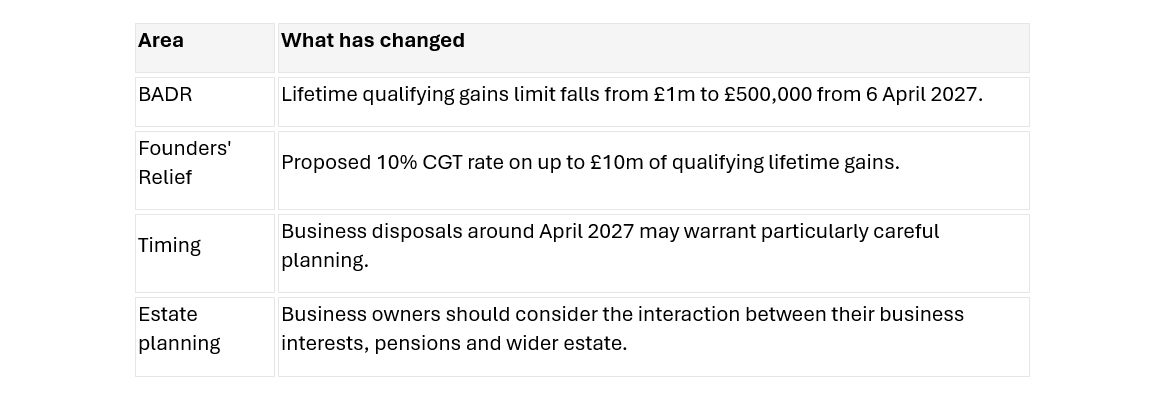
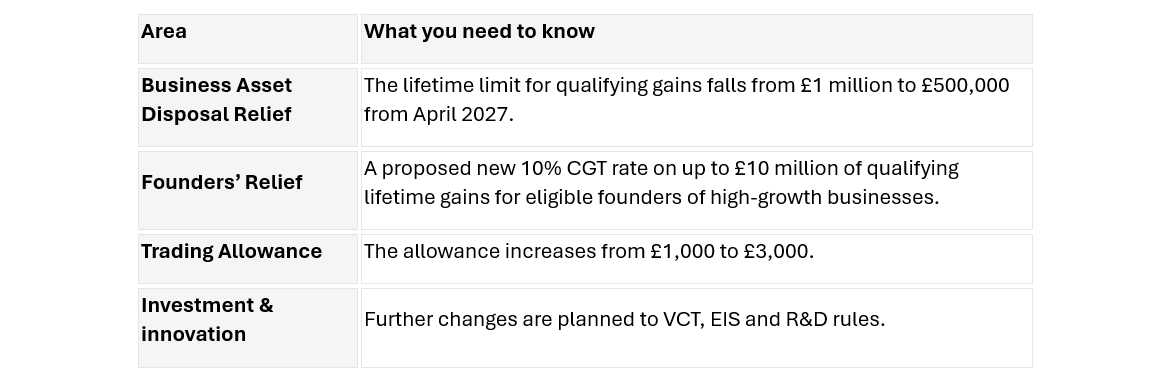
From 6 April 2027, the lifetime limit for Business Asset Disposal Relief (BADR) will fall from £1 million to £500,000.
At the same time, the Government is proposing a new Founders' Relief, offering a 10% rate on up to £10 million of lifetime gains for founders of qualifying high-growth companies from April 2027. The detailed rules remain subject to consultation.
On the face of it, £10 million of gains at 10% sounds more generous. The crucial words, however, are “qualifying founders”. Relatively few entrepreneurs may ultimately qualify and highlights the proposed requirement around the business reaching £10 million of annual revenue.
So, we would be cautious about business owners assuming that the new relief will apply to them until the rules are finalised.
For anyone contemplating a business sale or succession in the next few years, however, these changes make timing and forward planning more important, not less.
At a glance for business owners
Other notable announcements
Not everything in a Budget warrants changing a financial plan, but several other announcements caught our attention.
First-time buyers
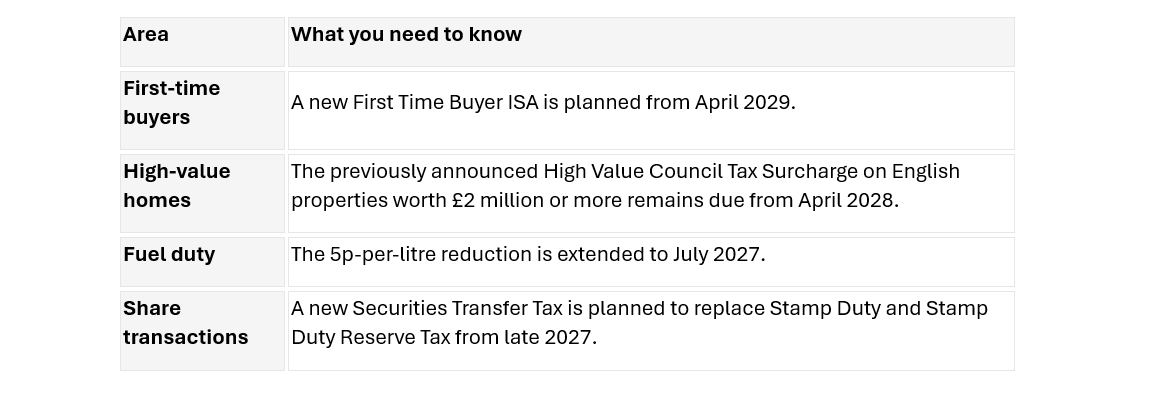
A new First Time Buyer ISA is planned from April 2029 and will replace the Lifetime ISA for new savers.
It is expected to permit contributions of up to £4,000 a year, together with a 25% Government bonus, subject to a maximum £20,000 bonus, towards a first home costing up to £450,000. Existing Lifetime ISAs will continue.
From 29 October 2026, the charge for using a Lifetime ISA towards the purchase of a home costing more than £450,000 falls from 25% to 20%.
High-value homes
The previously announced High Value Council Tax Surcharge, better known as “The Mansion Tax”, on homes in England is still due to begin in April 2028, with its £2 million threshold retained.
Salary sacrifice
Another previously announced measure remains important for anyone making significant pension contributions through salary sacrifice: the restriction on the National Insurance saving from salary-sacrifice pension contributions remains scheduled for April 2029.
These measures are some way off, but retirement planning often involves decisions that extend many years into the future, so they should not simply be ignored until the year in which they take effect.
So, what do we make of it?
Perhaps “breathing space” isn't a bad description after all.
For many households there was no dramatic Budget-day shock. But we wouldn't describe this as a Budget in which nothing happened either.
Much still rests on the Government actually delivering its planned reduction in the deficit. Uncertainty about the Government’s finances, particularly how much it will spend, raise in tax and need to borrow in the future is likely to persist, with spending pressures and future decisions still to come.
From a personal financial-planning perspective, however, we think the direction is becoming increasingly clear.
The tax environment is making it more important to think about where wealth is held, not simply how much wealth you have.
Cash inside or outside an ISA matters. Investments held personally or within tax-efficient wrappers matter. How and when pension wealth is drawn may matter increasingly for estate planning. And business owners need to think about the relationship between CGT, succession planning and Inheritance Tax well before they actually sell or transfer a business.
None of that is an argument for making knee-jerk changes in response to a Budget.
Quite the opposite.
Good financial planning is about looking at your objectives first, and then arranging your pensions, investments, cash and other assets as sensibly as possible around the tax rules that apply.
There will inevitably be more detail to digest, particularly where measures remain subject to consultation. We will incorporate the relevant changes into our clients' ongoing planning and discuss them where they affect individual circumstances.
Because ultimately, the important part of a Budget isn't what makes the headlines on the day.
It's what, if anything, it means for you.
The Budget Highlights
Personal
Business
Employment
Other notable announcements